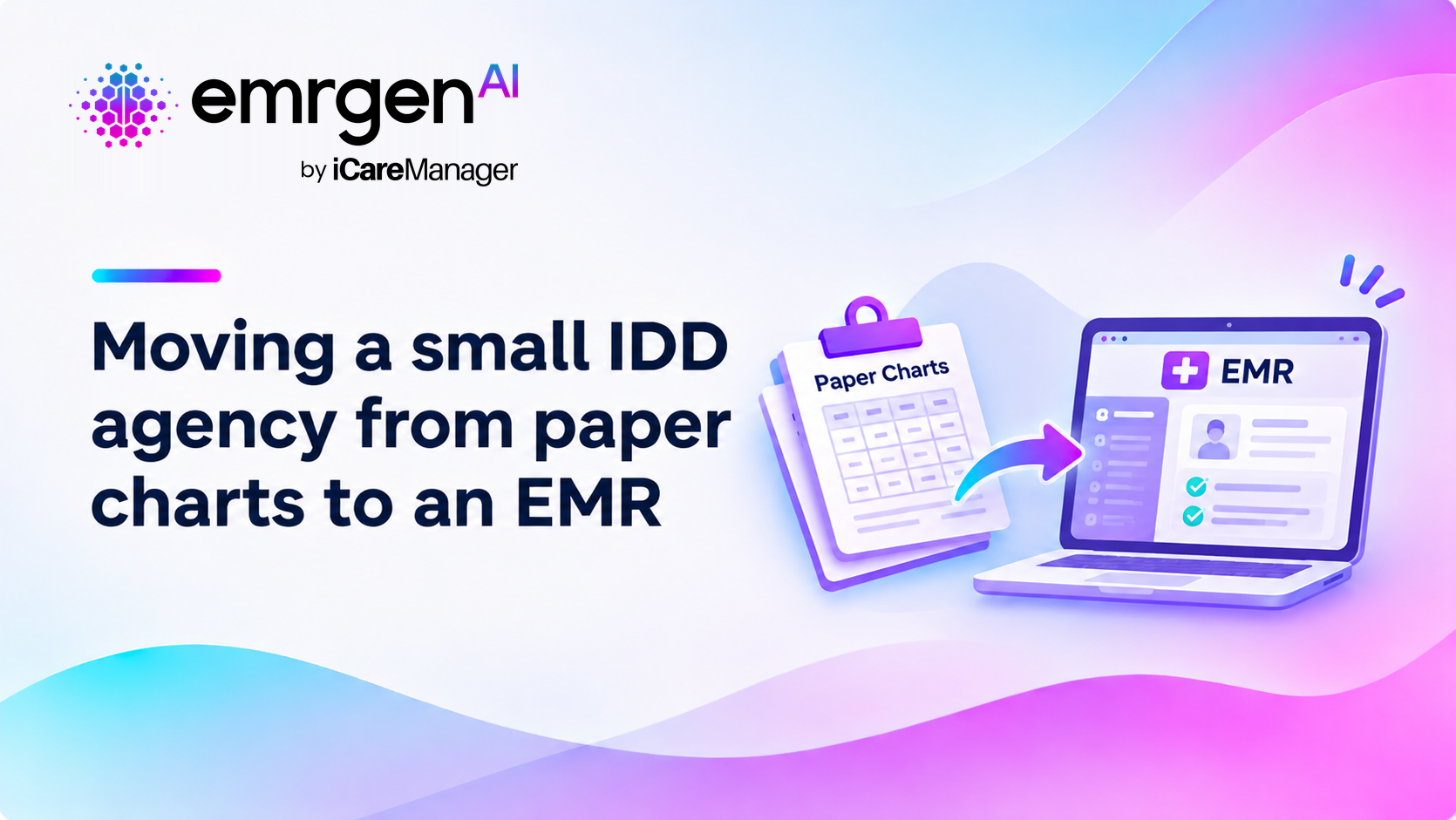
Moving a Small IDD Agency from Paper Charts to an EMR
If your small agency is leaving paper charts behind, what a system is called matters less than whether its functions fit your team's daily work in residential and community-based services. Compare options with a checklist rather than a ranking. Work in this order: records and billing, then plans, notes and connections, and finally scope and price.
EMRGEN is designed for IDD providers, IDD clinics, intermediate care facilities (ICFs) and behavioral health professionals.
Quick guide: Moving a small IDD agency from paper charts to an EMR
- Preparing the move: Plan the move carefully, including data migration planning so the new system can integrate and access historical data.
- Medicaid records and audits: EMRGEN offers one-click extraction of clinical and billing data for audits, Medicaid reviews and regulatory inspections.
- Person-centered plans: Check that care-plan and note templates can hold each person's goals, preferences and risk measures.
- Capture to signature: A note moves from ambient capture to an AI draft, then to clinician editing and a signed review.
- Care-system connections: Confirm which data synchronizes today, and treat coming-soon links as unavailable.
- Scope and price: Test each system against your workflows, and ask about unified or enterprise pricing.
How should you prepare to move off paper?
Moving from paper to a first system follows a few planning steps, and each step has something in EMRGEN to look at.
- Before implementation, Health IT Playbook guidance from the Office of the National Coordinator for Health Information Technology (ONC) lists setting up a governance process and a project plan, involving and communicating with staff and patients, redesigning workflows, and providing education and training. EMRGEN's team says customer conversations showed that providers needed a documentation system that understood their workflows, their compliance requirements and the people they serve.
- During implementation, the playbook lists tailoring the system to practice requirements, establishing a change management process, and accounting for training time as staff learn the system. EMRGEN gives you user management and access control, facility and location management, role-based permissions, template management, and favorites.
- Careful data migration planning helps make sure a new electronic health record (EHR) system can integrate and access historical data. EMRGEN's patient record is meant to hold what clinicians need to make informed decisions. Ask EMRGEN how your paper histories would be loaded into that record.
Will the EMR support Medicaid records and audits?
A State plan must provide for an agreement in which each provider furnishing services under it agrees to keep the records needed to show the extent of services given to beneficiaries, and to furnish them on request to the Medicaid agency, the Secretary, or the State Medicaid fraud control unit. To help with that, EMRGEN offers one-click extraction of clinical and billing data for audits, Medicaid reviews and regulatory inspections. EMRGEN accepts that the compliance obligation stays with your clinic, and describes its role as supplying tools for documentation, billing and audit requirements.
For billing, EMRGEN builds in Ambulatory Patient Groups (APG) crosswalk procedure codes for billing and claims processing for Medicaid reimbursement. Its Medicaid compliance tools add APG billing logic, International Classification of Diseases, Tenth Revision (ICD-10) code suggestions, and auto-generated Medicaid submissions. Check with your state Medicaid program which rules apply to each service you deliver.
Can the system represent person-centered plans?
A federal rule for Medicaid home and community-based services (HCBS) waiver programs sets out what a person-centered service plan must reflect. Use these plan requirements as checks when you look at any system's templates.
- Assessed needs and supports: The plan must reflect the services and supports a person needs, as identified through an assessment of functional need, including clinical and support needs. EMRGEN provides structured templates for goals, individualized care plans and outcomes tracking.
- Personal preferences: Check that EMRGEN's care-plan templates record each person's stated preferences as well as their goals.
- Risks and back-up plans: The plan must reflect risk factors and the measures that reduce them, including individualized back-up plans where needed. EMRGEN offers customizable templates, Subjective, Objective, Assessment, Plan (SOAP) notes, one-click signing, after-visit summaries, and print and e-Fax, and you can ask it to show how these handle the residential and community-based services your team documents.
How does an encounter move from capture to signed note?
With EMRGEN, the AI listens to encounters in real time, with transcription during visits, background noise filtering and multi-speaker recognition; it turns conversations into SOAP notes, and pending notes are reviewed and signed off with a single click.
- The AI documentation uses templates you can customize by specialty.
- Drafts can be refined with one-click editing.
- Single-click sign-off aims to avoid end-of-day backlogs. Follow your organization's own documentation procedure when signing AI-drafted notes, and confirm the review steps with your responsible clinical lead.
Which care-system connections should you verify?
EMRGEN uses shared scheduling, alerts and documentation logic so your team enters data once and it flows on from there. Check these points before you choose.
- Clinical data synced: The iCareManager sync covers patient demographics, vitals, medications and lab results.
- Goals and planning: It also brings across goals and planning trends from your care delivery platform.
- Direction of flow: Ask which data elements move in each direction.
- Coming-soon links: An Epic import of discharge summaries and hospital records is listed as coming soon, so treat coming-soon links as unavailable.
How should a small agency compare scope and price?
To compare an IDD-focused system with a general-purpose one, write down your daily workflows and test both systems against that list. EMRGEN's team says its work with customers covered needs ranging from regulatory compliance to APG billing.
On cost, EMRGEN offers unified system pricing. That means every module in one system, with no module-based pricing and no hidden fees. Organizations with 10 or more providers can ask for a custom enterprise quote.
Why EMRGEN may fit a small IDD agency
EMRGEN was created by the iCareManager team, which has spent years working with IDD providers, IDD clinics, ICFs and behavioral health organizations. Within the platform, care delivery by direct support professionals (DSPs) and nurses works together with clinical documentation by doctors and nurse practitioners (NPs). The demo is free, carries no commitment, and gives you a personalized walkthrough. See a personalized demo
Frequently Asked Questions
EMRGEN offers day, week and month calendar views, provider schedule setup, recurring appointments, automated notifications and reminders, and real-time availability.
EMRGEN offers certified electronic prescribing of controlled substances (EPCS) linked to pharmacies, so you can send and cancel prescriptions, handle refill requests, and run drug-drug and drug-allergy interaction checks. For labs, it supports electronic lab and imaging orders, combo orders, and results that arrive directly in the chart.
EMRGEN supports documentation for physical therapy, occupational therapy, speech-language pathology, psychology, social work and nursing in one system.
EMRGEN connects with health information exchanges to support care coordination. Ask which exchanges serve your area before you rely on this connection.