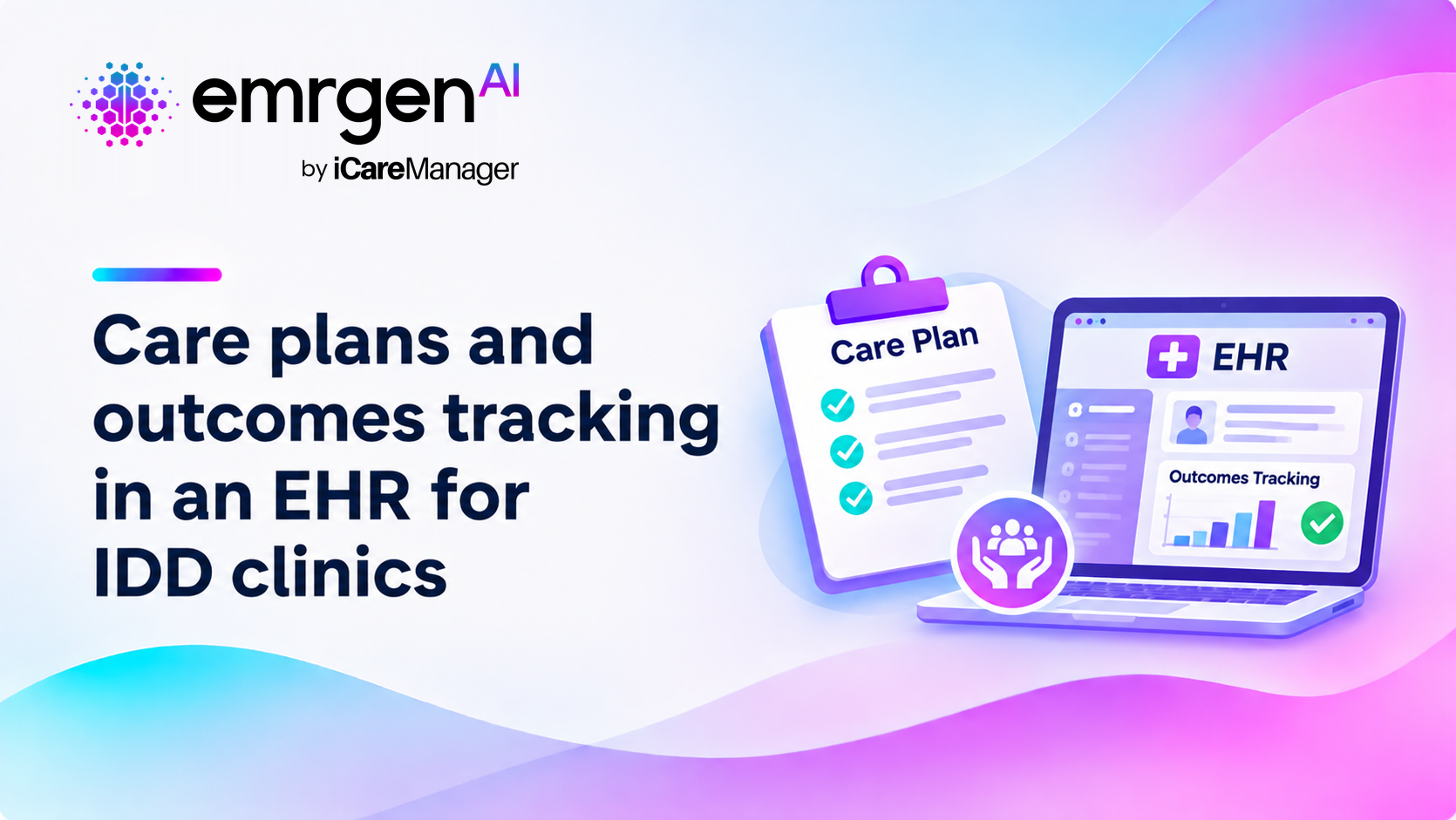
Care Plans and Outcomes Tracking in an EHR for IDD Clinics
For a small intellectual and developmental disabilities (IDD) provider moving off paper charts, the label on a system matters less than whether its functions match your team's daily work. EMRGEN presents itself as a complete clinical platform designed for intellectual and developmental disabilities providers, IDD clinics, intermediate care facilities (ICFs), and behavioral health professionals, with iCareManager integration.
IDD clinics, intermediate care facilities (ICFs) and behavioral health organizations comparing an electronic health record (EHR) can use the criteria that follow to test fit for themselves, rather than relying on a ranking.
Quick guide: Care plans and outcomes tracking in an EHR for IDD clinics
- Care plan elements: Test whether EMRGEN's care-plan templates capture needs, preferences, goals, risks and signatures.
- Multi-discipline notes: EMRGEN covers several clinical disciplines with flexible note tools, so test them against your own workflows.
- Connected data flow: Shared scheduling, alerts and documentation logic let data entered once flow everywhere, and iCareManager sync covers demographics, vitals, medications, lab results, goals and planning trends.
- AI note review: EMRGEN drafts Subjective, Objective, Assessment, Plan (SOAP) notes from the visit, and pending notes are reviewed and signed off with a single click.
- Fit, audits, price: Use a checklist, test audit extraction, and confirm unified or enterprise pricing.
Can the care plan capture individual needs, preferences, and outcomes?
A federal rule from the Centers for Medicare & Medicaid Services sets out what a person-centered service plan must reflect, and each element is worth testing in EMRGEN:
- Needs and preferences: The plan must reflect the services and supports a person needs, based on an assessment of functional need, along with their preferences for how those services are delivered. EMRGEN provides structured templates for individualized care plans, so check whether those templates can capture each person's stated preferences as well as their goals.
- Goals and outcomes: The plan must reflect the person's strengths and include individually identified goals and desired outcomes. EMRGEN offers structured templates for goals and outcomes tracking that are aligned with regulatory requirements.
- Risks and back-up plans: The plan must reflect risk factors and the measures that reduce them, including individualized back-up plans where needed. Ask EMRGEN to show how its templates handle the residential and community-based services your team documents.
- Agreement and signatures: The plan must be finalized with the person's written informed consent and signed by everyone responsible for carrying it out. EMRGEN includes one-click note signing. Ask how plan agreement and multiple signatures are recorded.
Will clinical notes work across disciplines and service settings?
EMRGEN supports documentation for all clinic services, including physical therapy (PT), occupational therapy (OT), speech-language pathology (SLP), psychology, social work, and nursing. A clinic that runs several disciplines can therefore keep their notes in one system rather than in separate tools.
EMRGEN's note tools also include customizable note templates, Subjective, Objective, Assessment, Plan (SOAP) note creation, after-visit summary generation, and print and e-Fax capabilities.
Breadth on paper still needs testing against your own work. To compare an IDD-focused system with a general-purpose one, list your own daily workflows and test both systems against that list. Then weigh how well each fits the residential and community-based services you document.
How does clinical information move between the care team and the record?
iCareManager powers care delivery while EMRGEN handles clinical documentation, all in one platform.
The Office of the National Coordinator for Health Information Technology (ONC) explains that interoperability allows authorized users to exchange electronic health information securely and seamlessly. Within EMRGEN, shared scheduling and alerts, together with shared documentation logic, mean your team enters data once and it flows everywhere.
ONC's certification program requires the United States Core Data for Interoperability (USCDI), a standard set of health data that includes clinical notes, lab results and medications. EMRGEN's data synchronization with your care delivery platform covers patient demographics, vitals, medications, lab results, goals and planning trends. Ask EMRGEN which data elements flow in each direction before you commit.
What does the AI note workflow ask clinicians to review?
The AI note workflow takes a visit through to a signed note:
- The AI provides real-time transcription during visits, with background noise filtering, recognition of multiple speakers, and audio processing that complies with the Health Insurance Portability and Accountability Act (HIPAA). In passive mode, the clinician can stay focused on care while the AI captures the encounter.
- The resulting SOAP notes are properly formatted to meet documentation standards, with templates that can be customized by specialty.
- Clinicians can edit and refine the draft with one click.
- This sign-off step is meant to help avoid end-of-day backlogs. When reviewing and signing AI-drafted notes, follow your organization's own documentation procedure and confirm the review steps with your responsible clinical lead.
How should a small provider test fit, audit needs, and price?
Run your own records, notes and plans through a trial rather than relying on a vendor's description.
Audit readiness is one test to include. Records should be accurate, clear and concise, maintained and available for review and audit, and EMRGEN offers one-click extraction of clinical and billing data for audits, Medicaid reviews, and regulatory inspections.
On cost, EMRGEN uses unified system pricing, which puts all modules in one unified system, with no hidden fees and no module-based pricing. Organizations with 10 or more providers can request a custom enterprise quote.
Why EMRGEN may fit an IDD care team
EMRGEN recognizes that the compliance obligation lies with your clinic, and it built its platform to give you the tools for documentation, billing, and audit requirements. If that matches your setting, bring your own care plans and workflows to a free, no-commitment, personalized walkthrough. See a personalized demonstration.
Frequently Asked Questions
EMRGEN offers patients and families secure access to health records, appointments, and care team communication. Ask how this access is set up for the people your organization supports.
EMRGEN includes built-in video visit support that automatically documents the modality, including justification for audio-only encounters. Include a remote visit in your trial to see how this appears in the note.
EMRGEN describes enterprise-grade encryption, granular access controls, and comprehensive audit trails to protect patient data. Its administration settings add facility and location management and template management.
EMRGEN offers flexible scheduling with multiple calendar views and automated reminders. EMRGEN also shows upcoming visits, alerts, tasks, and patient context at a glance, with AI-powered predictions.